
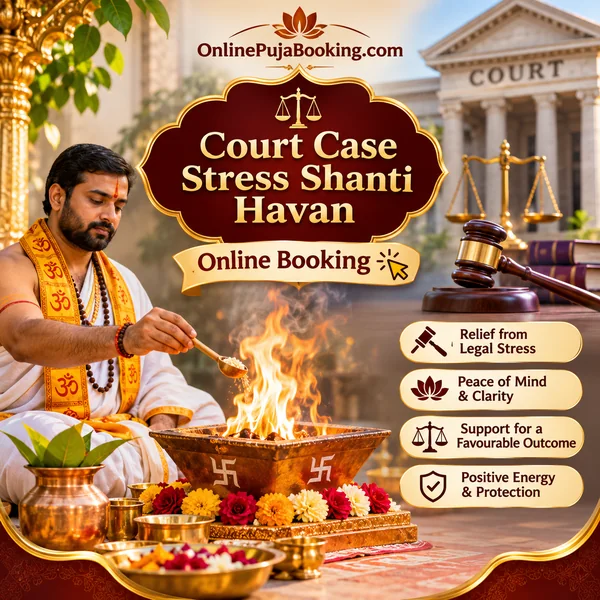

Court Case Stress Shanti Havan Online Booking
Facing a court case or prolonged legal dispute can be emotionally demanding for individuals and families. Legal proceedings may involve uncertainty, repeated hearings, financial pressure, disagreements, and concerns about the future. In Hindu devotional traditions, prayers and havans are sometimes performed during difficult periods to seek divine blessings, inner strength, peace, and clarity.
Court Case Stress Shanti Havan is a devotional fire ritual that may be arranged by individuals or families seeking spiritual support while dealing with legal challenges. Through a sacred fire offering, mantra recitation, and prayers to Hindu deities, devotees express their wishes for patience, wisdom, courage, harmony, and a peaceful resolution of difficult circumstances.
At OnlinePujaBooking.com, devotees can explore online booking options for this havan and review the available arrangements before requesting a preferred date.
Religious and Cultural Significance
In Hindu religious traditions, Agni (the sacred fire) is an important part of Vedic yajna and havan rituals. Offerings made into the consecrated fire are accompanied by mantras and prayers. The ritual represents devotion, purification, gratitude, and surrendering one’s concerns to the divine.
For people experiencing court-related stress, a Shanti Havan is understood as a spiritual expression of the desire for peace and balance. The worship may include prayers to:
Lord Ganesha: Lord Ganesha is traditionally worshipped at the beginning of auspicious religious activities. He is associated with wisdom, discernment, and the removal of obstacles in the devotional understanding of Hinduism. Devotees may pray to Him for clear thinking and the ability to approach difficult situations thoughtfully.
Lord Shiva: Lord Shiva is revered as a symbol of spiritual transformation, compassion, and inner stillness. Prayers to Shiva may form part of a Shanti ritual intended to cultivate patience, courage, and emotional balance.
Agni Dev: Agni is central to Vedic fire rituals. Through the havan, devotees offer samagri while reciting appropriate mantras and expressing their sankalpa.
Depending on the priest’s tradition, the ritual may also include prayers to Navagraha or other deities. The exact combination is not universal and should be discussed before booking.
It is important to understand that a religious havan is not a legal procedure and does not influence a court’s independent decision-making. It is a devotional practice intended to provide spiritual support, not a substitute for an advocate, legal advice, evidence, or compliance with court requirements.
Sanskrit Shloka or Mantra
The following established mantras are suitable for devotional recitation during a havan involving Lord Ganesha and Lord Shiva.
1. Lord Ganesha Mantra
Sanskrit:
ॐ गं गणपतये नमः॥
Roman Transliteration:
Om Gam Ganapataye Namah.
Meaning:
Salutations to Lord Ganesha, the revered deity associated with wisdom and the removal of obstacles.
Relevance to This Havan:
Devotees may chant this mantra at the beginning of the ritual while praying for sound judgment, patience, and clarity when dealing with difficult legal circumstances.
2. Lord Shiva Mantra
Sanskrit:
ॐ नमः शिवाय॥
Roman Transliteration:
Om Namah Shivaya.
Meaning:
I offer my salutations to Lord Shiva.
Relevance to This Havan:
This well-known Shiva mantra is traditionally recited as an expression of devotion and surrender. During a Shanti Havan, devotees may use it as a prayer for inner peace, strength, and spiritual steadiness.
Traditional Purpose and Devotional Benefits
Court Case Stress Shanti Havan is performed with devotional intentions. Its traditional associations may include:
- Prayer for mental peace: Seeking calmness and emotional balance during uncertain legal proceedings.
- Wisdom and clear thinking: Offering prayers for thoughtful decisions and sound judgment.
- Courage and patience: Seeking spiritual strength to face repeated hearings and challenging circumstances.
- Family harmony: Praying for understanding and reduced tension among family members affected by a legal dispute.
- Removal of spiritual obstacles: Expressing devotion to Lord Ganesha for guidance through difficult situations.
- Positive outlook: Seeking divine blessings to maintain hope, discipline, and a constructive attitude.
- Peaceful resolution: Praying for fairness, harmony, and an appropriate resolution through lawful processes.
These are traditional devotional intentions and beliefs, not scientifically established effects or guaranteed results. The havan cannot determine a legal judgment or guarantee that a dispute will end in a particular way.
When Is This Puja Performed?
There is no single universally mandatory date for Court Case Stress Shanti Havan. It may be arranged whenever an individual or family wishes to perform a prayer for peace and spiritual strength during a legal difficulty.
Some devotees prefer to perform a Shanti Havan on an auspicious date selected with the guidance of their family priest. Others may choose a convenient date based on personal circumstances.
Common considerations include:
- A period of ongoing court proceedings.
- Before an important hearing, as a personal devotional prayer.
- During prolonged property or inheritance disputes.
- When family disagreements have created emotional stress.
- On a suitable date selected according to family tradition or the priest’s guidance.
Monday is traditionally associated with Lord Shiva worship, while many devotees prefer auspicious tithis or other dates recommended by their priest. However, no particular weekday or tithi is compulsory for every version of this havan.
Who Can Book This Puja?
This havan may be relevant to:
Individuals involved in court cases: People facing civil, criminal, property, or other legal proceedings who wish to offer prayers for patience and peace.
Families dealing with legal disputes: Families experiencing stress because of inheritance, property division, or other disagreements may arrange a collective prayer.
People facing prolonged litigation: Individuals who find the uncertainty of repeated hearings emotionally demanding may seek spiritual comfort through a Shanti ritual.
Couples experiencing legal disagreements: Devotees dealing with matrimonial or family-related legal proceedings may choose to pray for peace and mutual understanding.
Business owners: Entrepreneurs and business families involved in commercial disputes may arrange the havan as a personal expression of faith.
There is no requirement that only the person named in a court case must participate. Family members may also join, according to the ritual arrangements.
Puja Vidhi: How the Ritual Is Traditionally Performed
The exact procedure depends on the priest, regional tradition, and selected ritual package. A customary Shanti Havan may include the following stages:
1. Preparation of the Puja Area
The ritual area is cleaned and prepared. A havan kund is arranged in a suitable place, and commonly required religious materials are assembled.
2. Achamana and Sankalpa
The priest may begin with achamana and other preliminary prayers. The devotee then takes a sankalpa, stating the intention of performing the havan. For this particular ritual, the sankalpa may express a prayer for peace, patience, wisdom, and spiritual strength during legal difficulties.
3. Invocation of Lord Ganesha
Lord Ganesha is traditionally worshipped before the principal ritual. The priest may offer flowers, durva, incense, and other customary offerings while chanting appropriate mantras.
4. Kalasha Sthapana and Preliminary Prayers
Where included in the chosen tradition, a kalasha may be established and worshipped. Prayers may be offered to the deities associated with the ritual.
5. Invocation of Agni Dev
The sacred fire is established in the havan kund using appropriate materials. Agni Dev is invoked through traditional mantras and offerings.
6. Mantra Jaap and Havan Offerings
The priest recites the selected mantras and makes offerings into the sacred fire. Depending on the ritual, these may include ghee, havan samagri, herbs, grains, and other traditional ingredients.
7. Shiva Shanti Prayers
If Lord Shiva worship is part of the selected arrangement, the priest may recite Om Namah Shivaya or other appropriate prayers. The devotee offers prayers for peace, strength, and clarity.
8. Purnahuti
The ritual may conclude with purnahuti, the final offering into the sacred fire. This represents the completion of the havan and the devotee’s offering of prayers.
9. Shanti Path and Prasad
The priest may recite peace prayers and distribute prasad according to the customary procedure.
The steps described above are a general overview, not a fixed prescription for every tradition. The priest may adjust the ritual according to the selected package and religious custom.
Puja Samagri
Commonly used materials may include:
- Havan kund and suitable firewood or samidha.
- Ghee and traditional havan samagri.
- Camphor and incense.
- Flowers and garlands.
- Turmeric, kumkum, and sandalwood paste.
- Akshata (rice mixed with turmeric).
- Fruits and seasonal offerings.
- Coconut.
- Betel leaves and betel nuts.
- Kalasha and clean water, if required.
- Lord Ganesha and Lord Shiva worship materials.
- Prasad ingredients.
The exact list may differ depending on the priest and the selected ritual format. Please confirm whether samagri, priest arrangements, and other requirements are included in your chosen package before booking.
Why Book Through OnlinePujaBooking.com?
Arranging a religious ceremony while managing legal responsibilities can be challenging. OnlinePujaBooking.com provides a convenient way to explore puja booking options without having to begin the process through in-person enquiries.
You can review the available Court Case Stress Shanti Havan service details, check package inclusions, and request a preferred date. The booking process also gives you an opportunity to communicate important requirements before the service is confirmed.
Our aim is to make the process of exploring Hindu puja services straightforward while respecting the religious significance of the ritual.
Before placing your booking, review the following:
- The selected havan format and its intended procedure.
- Whether the priest arrangement is included.
- Whether puja samagri is included.
- The expected duration and location arrangements.
- Any additional requirements for the devotee.
- The requested date and confirmation of availability.
How to Book Court Case Stress Shanti Havan Online
Booking your Court Case Stress Shanti Havan through OnlinePujaBooking.com can be approached in a few simple steps:
Step 1: Find the Puja Service
Visit OnlinePujaBooking.com and locate the Court Case Stress Shanti Havan service listing.
Step 2: Review the Package Details
Read the description carefully and check the selected package, ritual inclusions, samagri arrangements, and service conditions.
Step 3: Select Your Preferred Date
Choose your preferred date or submit a date request. The date will be subject to availability and confirmation.
Step 4: Provide Booking Information
Enter the required contact details and any relevant service information requested during booking. You do not need to share confidential court documents or sensitive legal information for a devotional booking unless specifically required for a clearly explained service purpose.
Step 5: Confirm Service Arrangements
Review the booking details and communicate any questions about the ritual, location, duration, or materials.
Step 6: Receive Booking Confirmation
Proceed according to the website’s booking instructions and check the confirmation details before the scheduled puja.
Frequently Asked Questions (FAQs)
1. What is Court Case Stress Shanti Havan?
Court Case Stress Shanti Havan is a Hindu devotional fire ritual performed with prayers for peace, patience, wisdom, and spiritual strength during legal difficulties. It may include worship of Lord Ganesha, Lord Shiva, and Agni Dev according to the priest’s tradition.
2. Which deity is worshipped in this havan?
Lord Ganesha and Lord Shiva may be worshipped as part of the ritual. Agni Dev is also invoked as part of the fire ceremony. Additional deity worship may vary according to the selected ritual procedure.
3. What is the religious significance of this havan?
The havan represents devotion, prayer, and the offering of one’s concerns to the divine through sacred fire. Devotees perform it with the intention of seeking peace, clarity, courage, and strength during difficult circumstances.
4. What are the traditional devotional benefits?
Traditionally, devotees pray for mental calmness, patience, wise decisions, family harmony, spiritual protection, and a peaceful resolution of difficulties. These are devotional intentions rather than guaranteed practical or legal outcomes.
5. When should Court Case Stress Shanti Havan be performed?
It may be performed whenever devotees wish to pray during an ongoing legal matter. An auspicious date can be requested with guidance from a priest, but there is no universally compulsory date.
6. Can this havan be arranged at home?
Yes, a home-based havan may be possible if the selected service supports it and there is a suitable, safe space for the fire ritual. Confirm the location and arrangements before booking.
7. Can I book Court Case Stress Shanti Havan online?
You can explore the service and submit a booking request through OnlinePujaBooking.com. Review the available package details and follow the website’s confirmation process.
8. What samagri is required for this havan?
Common materials include ghee, havan samagri, samidha, flowers, fruits, coconut, incense, and materials for Ganesha and Shiva worship. The final requirements depend on the priest’s procedure and selected package.
9. How long does the havan take?
The duration depends on the number of mantras, offerings, preliminary worship, and the selected ritual format. Please check the expected duration with the service provider before confirming.
10. Can I request a preferred puja date?
Yes, you may request a preferred date while booking. The requested date should be treated as subject to availability and confirmation.
11. Do I need to share court case documents for the puja?
A devotional havan generally does not require confidential court documents. You may provide basic booking information and the general intention for the sankalpa, as requested by the priest. Avoid sharing sensitive legal or personal information unnecessarily.
12. Does Court Case Stress Shanti Havan guarantee a favourable court judgment?
No. A havan cannot guarantee a favourable judgment, dismissal of a case, victory in litigation, or any particular legal outcome. It is a religious practice intended for spiritual support and peace. Devotees should continue to follow their advocate’s advice and all applicable legal procedures.
Book Court Case Stress Shanti Havan Online
If you or your family are experiencing the emotional pressure of an ongoing court case, Court Case Stress Shanti Havan can be considered as a devotional prayer for peace, patience, courage, and clarity. Explore the available ritual arrangements through OnlinePujaBooking.com, review the package inclusions, and request your preferred date. May your prayers bring spiritual strength, wisdom, and harmony as you continue to pursue the appropriate legal process.
Reviews
There are no reviews yet.