
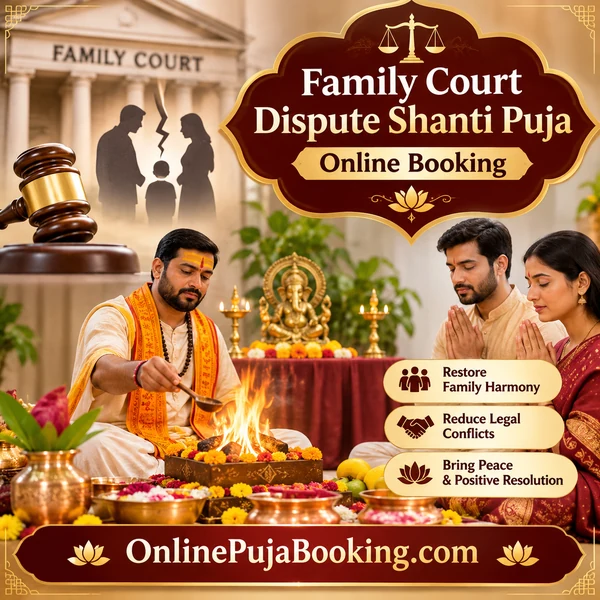

Family Court Dispute Shanti Puja Online Booking
Family disputes can bring emotional strain, uncertainty, and difficulty in communication. When a disagreement reaches family court, the experience may affect not only the people directly involved but also children and other family members. Family Court Dispute Shanti Puja is a devotional Hindu prayer ceremony that may be arranged by individuals or families seeking spiritual strength, peace of mind, patience, and goodwill during a challenging period.
This service name describes a purpose-oriented devotional ceremony rather than one single, universally prescribed Vedic ritual. The exact form may be adapted by the performing priest according to the devotee’s family tradition, regional customs, and selected package. The ceremony may include worship of Lord Ganesha and Lord Shiva, a sankalpa (devotional intention), mantra recitation, and prayers for peace and harmony.
The puja is a spiritual observance. It does not replace legal representation, court procedures, counselling, mediation, or any direction issued by a court. It should not be presented as a way to influence a judge, control another person, or guarantee a particular legal outcome.
Religious and Cultural Significance
In Hindu devotional practice, prayer is often an expression of surrender, hope, self-reflection, and a wish to act with wisdom during difficult circumstances. A family court dispute may involve disagreements between spouses, questions concerning children, maintenance, separation, property within a family, or other domestic matters. A shanti-oriented puja gives devotees an opportunity to pause, pray, and seek the strength to approach these circumstances with patience and dignity.
Lord Ganesha is traditionally worshipped at the beginning of many Hindu ceremonies. Devotees seek his blessings for wisdom, discernment, and the ability to approach obstacles thoughtfully. Beginning the ceremony with Ganesh Puja is therefore a customary choice for a prayer connected with a difficult family situation.
Lord Shiva is revered in many Hindu traditions as a source of auspiciousness, compassion, and spiritual stillness. Devotees may recite the Panchakshara mantra, “Om Namah Shivaya,” as an expression of reverence and a prayer for inner steadiness.
Depending on family custom, a priest may also include prayers to Lord Vishnu, Goddess Parvati, or the family’s Ishta Devata. These additions are not mandatory components of a universally established “Family Court Dispute Shanti Puja.” They should be agreed upon according to the chosen ritual arrangement.
The central intention is not to seek victory over another family member. It is to pray for calm communication, fair conduct, mutual understanding where possible, and the strength to make responsible decisions.
Sanskrit Shloka or Mantra
The following are established devotional invocations that may be included where appropriate to the selected puja format.
1. Traditional Invocation to Lord Ganesha
Sanskrit (Devanagari):
वक्रतुण्ड महाकाय सूर्यकोटि समप्रभ।
निर्विघ्नं कुरु मे देव सर्वकार्येषु सर्वदा॥
Roman Transliteration:
Vakratunda Mahakaya Suryakoti Samaprabha,
Nirvighnam Kuru Me Deva Sarva Karyeshu Sarvada.
Meaning:
“O Lord with the curved trunk and mighty form, whose radiance is like millions of suns, please bless my undertakings so that I may proceed without obstacles.”
Relevance to this puja:
This traditional invocation is recited by devotees when beginning religious activities. In this ceremony, it may express a prayer for wisdom, clarity, and the ability to handle family and legal responsibilities thoughtfully.
2. Shiva Panchakshara Mantra
Sanskrit (Devanagari):
ॐ नमः शिवाय॥
Roman Transliteration:
Om Namah Shivaya.
Meaning:
“Om, salutations to Lord Shiva.”
Relevance to this puja:
This well-known Shaiva mantra is a devotional salutation to Lord Shiva. Its recitation may form part of a prayer for peace, patience, self-discipline, and spiritual strength during a stressful family situation.
The priest or devotee may follow the pronunciation, recitation method, and number of repetitions customary in their own tradition. No particular repetition count is compulsory for every family.
Traditional Purpose and Devotional Benefits
Devotees may undertake Family Court Dispute Shanti Puja with the following spiritual intentions:
- Prayer for family peace: To express a sincere wish for reduced hostility and a more peaceful family environment.
- Patience during proceedings: To seek the strength to respond calmly rather than act out of anger or distress.
- Wisdom in decision-making: To pray for clear thinking when considering important family and personal responsibilities.
- Respectful communication: To seek goodwill and understanding among family members wherever reconciliation or cooperation is possible.
- Well-being of children: To offer prayers for the emotional welfare, stability, and care of children affected by family disagreements.
- Fairness and responsible conduct: To seek the courage to act honestly and respect lawful processes.
- Emotional and spiritual support: To create time for prayer, reflection, and connection with one’s chosen deity.
These are devotional intentions and traditional religious associations. The puja cannot guarantee reconciliation, a favourable court order, custody arrangements, settlement, or any other specific result.
When Is This Puja Performed?
Family Court Dispute Shanti Puja does not have one universally prescribed festival, tithi, or annual date. Since it is a purpose-oriented devotional ceremony, families may request it when they feel the need for prayer and spiritual support.
Possible occasions include:
- During an ongoing matrimonial or family court matter.
- Before or after an important hearing, if the family wishes to offer prayers.
- During a period of continuing disagreement or tension within the family.
- When seeking peace and strength before a mediation or settlement discussion.
- On a personally meaningful day or a date suggested by the family priest.
Some families prefer Monday for Shiva worship, while others may choose a date according to their family tradition or the priest’s guidance. An auspicious date is not a substitute for attending a court hearing, meeting a legal deadline, or following a court direction.
Who Can Book This Puja?
This puja may be requested by:
- A husband or wife involved in matrimonial proceedings.
- A parent concerned about a family dispute affecting children.
- A family member seeking peace during separation or other domestic disagreements.
- A person facing a difficult family-related legal matter.
- Relatives who wish to pray for harmony and the well-being of the family.
- An individual who wishes to perform a private prayer for patience and clarity.
A person may arrange the puja individually. The participation of both parties is not required for someone to offer a personal prayer. However, no one should be pressured to participate or have their personal details used in a ritual without their consent.
Puja Vidhi: How the Ritual Is Traditionally Performed
The precise procedure depends on the priest, regional custom, and package selected. A possible format for a Family Court Dispute Shanti Puja is outlined below.
Step 1: Preparation and purification
The place of worship is cleaned and prepared. The priest may arrange a puja altar, images or murtis of the selected deities, a kalash, and the required offerings. The devotee may take a bath and wear clean clothes before the ceremony.
Step 2: Sankalpa
The devotee takes a sankalpa, or devotional resolve, stating the intention behind the prayer. The intention may be for peace in the family, patience, wisdom, the welfare of children, and a fair and peaceful resolution of the dispute. Sensitive legal details need not be announced publicly.
Step 3: Ganesh Puja
The ceremony may begin with prayers to Lord Ganesha. Flowers, durva grass, incense, and other customary offerings may be presented according to the priest’s tradition.
Step 4: Worship of the principal deity
The priest may perform Shiva Puja or another agreed form of deity worship. Offerings such as water, flowers, bilva leaves, or other suitable items may be used according to the selected form of worship.
Step 5: Mantra recitation
The priest or devotee may recite the Ganesh invocation and Shiva mantra. Additional prayers for peace and family harmony may be included where appropriate.
Step 6: Shanti prayers and offerings
A prayer for peace may be offered for all family members. If the selected package includes a havan, the priest may conduct the fire ritual with suitable offerings and mantras. Havan should not be assumed to be included unless it is specifically stated in the package.
Step 7: Aarti and concluding prayer
The ceremony may conclude with aarti, a final prayer, and distribution of prasad where arranged. The devotee may offer a personal prayer for strength, clarity, compassion, and responsible action.
This is an illustrative outline, not a mandatory sequence for every Hindu tradition. The performing priest may adapt the procedure to the selected package and customary practice.
Puja Samagri
Common materials that may be used, depending on the ritual format, include:
- A picture or murti of Lord Ganesha and the selected principal deity.
- Flowers and garlands.
- Incense sticks and a diya.
- Camphor for aarti.
- Fruits and customary naivedya.
- Turmeric, kumkum, sandalwood paste, and akshata (rice grains).
- Water and a kalash.
- Durva grass for Ganesh worship, where customary.
- Bilva leaves for Shiva worship, where included.
- Havan samagri, ghee, and a suitable havan kund, if havan is part of the package.
The exact list depends on the priest’s method and the selected service. Customers should confirm whether samagri, havan arrangements, prasad, and any other materials are included before booking.
Why Book Through OnlinePujaBooking.com?
OnlinePujaBooking.com provides a convenient way to explore and request Hindu puja services online. When considering Family Court Dispute Shanti Puja, customers can review the available service information, check package details, and communicate their preferred date and requirements.
A family-related legal matter can be sensitive. Customers should share only the information necessary to arrange the ceremony. There is no need to disclose confidential legal documents, private allegations, or personal details about another family member unless a specific detail is genuinely required and the customer chooses to share it.
Before confirming, review the stated inclusions carefully. The exact ritual format, priest arrangements, samagri, location, duration, and any havan component should be clarified through the booking communication.
How to Book Family Court Dispute Shanti Puja Online
- Find the puja service: Visit OnlinePujaBooking.com and locate Family Court Dispute Shanti Puja.
- Review the package: Read the description and check the listed ritual components, inclusions, and service arrangements.
- Request your preferred date: Select or communicate a suitable date. The requested date remains subject to confirmation.
- Provide booking details: Share your name, contact information, preferred location or ceremony format, and any relevant requirements requested for the booking.
- Confirm the arrangements: Clarify the puja procedure, samagri, duration, and whether havan is included.
- Receive booking confirmation: Proceed according to the confirmation and instructions provided for the selected service.
Frequently Asked Questions (FAQs)
1. What is Family Court Dispute Shanti Puja?
It is a purpose-oriented Hindu devotional ceremony arranged by individuals or families seeking peace, patience, wisdom, and harmony during a family-related legal dispute. The ritual format may include Ganesh Puja, Shiva worship, sankalpa, mantra recitation, and shanti prayers.
2. Which deity is worshipped in this puja?
Lord Ganesha and Lord Shiva may be worshipped as part of the ceremony. Other deities, such as Lord Vishnu, Goddess Parvati, or the family’s Ishta Devata, may be included according to the family’s tradition and the agreed ritual format.
3. What is the religious significance of this puja?
The ceremony provides an opportunity to pray for inner strength, calm communication, responsible decisions, and peace among family members. It is a devotional observance rather than a prescribed legal remedy.
4. What are the traditional benefits of performing this puja?
Devotees may pray for patience, emotional steadiness, family harmony, the welfare of children, and the wisdom to handle difficult circumstances. These are spiritual intentions, not guaranteed outcomes.
5. When should Family Court Dispute Shanti Puja be performed?
It may be arranged during an ongoing family dispute or at a time when the devotee wishes to seek spiritual support. There is no single mandatory tithi or festival for this purpose-oriented ceremony.
6. Can this puja be performed at home?
A home ceremony may be possible depending on the selected service and arrangements. Customers should confirm the location, priest availability, ritual format, and any space or fire-safety requirements before booking.
7. Can I book Family Court Dispute Shanti Puja online?
You can submit a booking request through OnlinePujaBooking.com. The preferred date, service format, and other arrangements should be treated as confirmed only after receiving booking confirmation.
8. What samagri is required for this puja?
Common materials may include flowers, fruits, incense, a diya, turmeric, kumkum, rice, and deity-specific offerings. Bilva leaves or durva grass may be used when the corresponding deity worship is included. The final list depends on the selected ritual.
9. How long does the puja take?
The duration depends on whether the ceremony includes only basic deity worship and mantra recitation or also includes an extended path, additional offerings, or havan. Confirm the expected duration with the service team before booking.
10. Can I request a preferred puja date?
Yes. You may request a preferred date while booking. It is subject to availability and must be confirmed before the ceremony is considered scheduled.
11. What should I confirm before booking?
Check the ritual procedure, principal deity, package inclusions, samagri arrangements, location, expected duration, havan requirements, and booking confirmation. Share only the personal information needed to coordinate the service.
12. Does this puja guarantee a favourable family court decision?
No. No puja can guarantee a court decision, reconciliation, custody arrangement, settlement, or any other legal result. The ceremony is a form of religious devotion and spiritual support. Continue to follow legal advice, court directions, and applicable deadlines.
Final Booking Call to Action
If you and your family wish to offer prayers for peace, patience, wisdom, and harmony during a difficult family court matter, explore Family Court Dispute Shanti Puja on OnlinePujaBooking.com. Review the available package details, request your preferred date, and confirm the ritual arrangements before booking. May your prayers inspire strength, compassion, and thoughtful decisions during this challenging time.


Reviews
There are no reviews yet.