
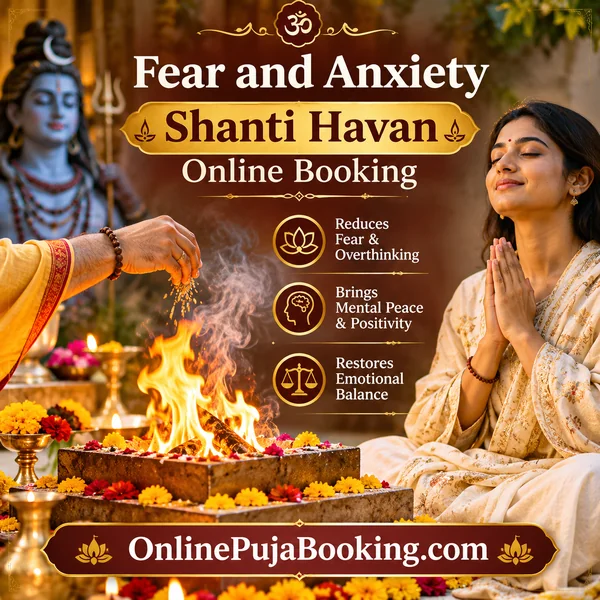

Fear and Anxiety Shanti Havan Online Booking
Fear and Anxiety Shanti Havan is a Hindu Vedic-style fire ritual performed as a devotional prayer for courage, peace, spiritual strength, and divine guidance. The word Shanti means peace, while Havan refers to a sacred fire ceremony in which offerings are made into the fire with the recitation of mantras.
People may turn towards prayer and traditional Hindu rituals during periods of uncertainty, persistent worry, difficult life transitions, or situations that make them feel spiritually unsettled. Through this havan, devotees express their faith and seek blessings for a calm mind, courage, positive thinking, and the strength to face life’s challenges.
The specific deity worshipped may differ according to family tradition and the ritual selected. Lord Shiva, Lord Hanuman, and Goddess Durga are among the deities whose worship is traditionally associated with peace, courage, and divine protection. The priest may recommend the appropriate prayers and mantras after considering the devotee’s sankalpa.
OnlinePujaBooking.com provides a convenient way to explore Fear and Anxiety Shanti Havan booking options and communicate your preferred requirements.
Religious and Cultural Significance
In Hindu religious tradition, fear and anxiety are often approached through devotion, prayer, mantra recitation, meditation, and surrender to the Divine. Shanti rituals are performed with the intention of establishing spiritual harmony and seeking blessings during challenging circumstances.
Fire holds an important place in Vedic ritual traditions. Agni, the sacred fire, is regarded as a divine presence and a medium through which offerings are made during a yajna or havan. Mantras are recited while offerings such as ghee and appropriate havan materials are placed into the fire.
The purpose of Fear and Anxiety Shanti Havan is devotional rather than medical. It gives devotees an opportunity to pray for:
- Courage when facing uncertain situations.
- Peace and steadiness during difficult periods.
- Strength to approach responsibilities with confidence.
- Protection and guidance through divine blessings.
- Harmony within the household.
- Greater faith and spiritual discipline.
Different Hindu traditions may prescribe different deities, mantras, and ritual procedures. Therefore, this havan should not be understood as one universally fixed ceremony with an identical procedure everywhere.
It is also important to distinguish spiritual practice from professional healthcare. A havan may be meaningful as a religious and personal practice, but it is not a substitute for medical or mental health care when anxiety or fear is affecting daily life.
Sanskrit Shloka or Mantra
The following well-known mantras are appropriate devotional prayers for seeking peace and divine reassurance. They are presented as general prayers rather than as exclusive mantras prescribed for one fixed Fear and Anxiety Shanti Havan procedure.
1. Om Namah Shivaya
Sanskrit:
ॐ नमः शिवाय।
Roman Transliteration:
Om Namah Shivaya.
Meaning:
I bow to Lord Shiva, the auspicious and benevolent Divine.
Relevance to This Havan:
Lord Shiva is worshipped by devotees seeking peace, spiritual strength, and freedom from inner disturbances. Reciting this mantra during a Shiva-oriented Shanti Havan expresses devotion and the desire for divine guidance and calmness.
2. Mahamrityunjaya Mantra
Sanskrit:
ॐ त्र्यम्बकं यजामहे सुगन्धिं पुष्टिवर्धनम्।
उर्वारुकमिव बन्धनान्मृत्योर्मुक्षीय मामृतात्॥
Roman Transliteration:
Om Tryambakam Yajamahe Sugandhim Pushtivardhanam,
Urvarukamiva Bandhanan Mrityor Mukshiya Maamritat.
Meaning:
We worship the three-eyed Lord Shiva, who nourishes and sustains all beings. May He release us from the bondage of death, just as a ripe fruit separates naturally from its stem, without separating us from immortality.
Relevance to This Havan:
This ancient Shiva mantra is widely recited in Hindu devotional practice for prayers concerning well-being, protection, courage, and spiritual strength. It may be included in a Shiva-oriented havan when appropriate to the selected ritual tradition.
Traditional Purpose and Devotional Benefits
Fear and Anxiety Shanti Havan is performed with several devotional intentions. These are traditional religious associations and personal prayers, not scientifically established effects or guaranteed outcomes.
- Prayer for Courage: Devotees seek Lord Shiva’s or Lord Hanuman’s blessings for courage when facing challenging circumstances.
- Prayer for Mental Peace: The ritual provides an opportunity to focus on prayers, mantra recitation, and spiritual reflection.
- Seeking Divine Protection: Devotees may pray to Goddess Durga or Lord Hanuman for strength and divine protection.
- Strength During Uncertainty: Families may perform the havan when facing important decisions or uncertain life situations.
- Positive Family Environment: The ceremony may be performed as a collective prayer for peace and harmony within the home.
- Spiritual Confidence: Mantra recitation and devotional participation can help devotees strengthen their personal connection with their faith.
- Sankalpa and Devotion: The ritual gives individuals an opportunity to express their concerns and intentions before the Divine.
When Is This Puja Performed?
There is no single universally mandatory date for Fear and Anxiety Shanti Havan. It may be arranged whenever devotees wish to undertake a personal or family prayer for peace and courage.
Commonly considered occasions include:
- When beginning a new phase of life.
- During periods of personal uncertainty or family difficulties.
- When seeking spiritual reassurance before an important responsibility.
- During the observance of a family sankalpa.
- On a suitable Monday for a Shiva-oriented ritual.
- During Navratri or other suitable occasions for worship of Goddess Durga.
- On a Tuesday or Saturday for a Hanuman-oriented devotional observance, according to family custom.
The date and muhurat may be selected with guidance from the priest or according to the devotee’s regional and family traditions.
Who Can Book This Puja?
Fear and Anxiety Shanti Havan may be considered by:
- Individuals who wish to pray for courage and peace during uncertain times.
- Families seeking blessings for harmony and spiritual protection.
- Students facing important examinations or academic responsibilities.
- Professionals dealing with stressful work situations who wish to undertake a devotional prayer.
- Individuals preparing for a major life change.
- Devotees who regularly worship Lord Shiva, Lord Hanuman, or Goddess Durga.
- Families wishing to perform a collective Shanti Havan with a specific sankalpa.
There is no general restriction that only a particular age group or gender can participate. Specific observances and customary requirements may vary by tradition.
Puja Vidhi: How the Ritual Is Traditionally Performed
The exact procedure depends on the deity, mantra selection, regional tradition, and the priest conducting the ceremony. A customary havan may include the following stages:
1. Preparation of the Puja Area
The ritual space is cleaned and arranged. A havan kund is prepared in a suitable location, and the required puja materials are organized.
2. Ganesh Puja
Lord Ganesha is traditionally worshipped at the beginning of many Hindu ceremonies. Devotees pray for the smooth commencement of the ritual.
3. Sankalpa
The yajman or devotee takes a sankalpa, expressing the intention behind the havan. The sankalpa may mention the devotee’s name, family details, and prayer for courage, peace, and divine blessings.
4. Invocation of the Presiding Deity
The selected deity is worshipped through prayers and offerings. Depending on the chosen ritual, this may involve Lord Shiva, Lord Hanuman, or Goddess Durga.
5. Mantra Recitation
The priest recites the relevant devotional or traditional mantras. The number of repetitions and the specific mantra depend on the selected package and ritual method.
6. Havan and Sacred Offerings
A sacred fire is established in the havan kund. Offerings such as ghee and suitable havan samagri are offered while the prescribed mantras are recited.
7. Shanti Prayers
Prayers are offered for peace, courage, spiritual protection, and harmony. The concluding prayers may differ according to the tradition being followed.
8. Purnahuti
The ceremony is concluded with Purnahuti, the final offering into the sacred fire, followed by prayers and blessings.
9. Aarti and Prasad
Where included in the selected ritual, the ceremony concludes with aarti, devotional prayers, and distribution of prasad.
These steps describe a general customary structure. They should not be considered a compulsory or identical procedure for every tradition.
Puja Samagri
Commonly used materials for a Shanti Havan may include:
- Havan kund.
- Dry wood or approved havan fuel.
- Ghee.
- Havan samagri.
- Camphor.
- Incense sticks and dhoop.
- Flowers and garlands.
- Kumkum, turmeric, and sandalwood.
- Rice or akshat.
- Fruits and other suitable offerings.
- Kalash and clean water.
- Coconut, where required.
- Aasan for the priest and yajman.
- Items required for the selected deity’s worship.
The actual samagri list depends on the chosen deity and ritual procedure. Customers should confirm whether the havan materials, puja arrangements, and other offerings are included in their selected package.
Why Book Through OnlinePujaBooking.com?
Planning a religious ceremony involves several details, including the preferred date, type of puja, ritual requirements, and service arrangements.
OnlinePujaBooking.com offers a convenient way to explore puja services and review available booking options.
When considering Fear and Anxiety Shanti Havan, customers can:
- Explore the relevant puja service online.
- Review the package description and stated inclusions.
- Request a preferred date for the ceremony.
- Share the devotee’s details required for the sankalpa.
- Communicate questions about samagri and ritual arrangements.
- Review the booking information and seek confirmation before proceeding.
The exact service arrangements should always be checked before completing a booking. Priest availability, location, ceremony format, duration, and package inclusions should be confirmed individually.
How to Book Fear and Anxiety Shanti Havan Online
Follow these practical steps to request your puja booking:
Step 1: Find the Puja Service
Visit OnlinePujaBooking.com and locate Fear and Anxiety Shanti Havan.
Step 2: Review the Package
Read the service description carefully. Check the stated ritual details, inclusions, samagri arrangements, and applicable booking conditions.
Step 3: Select Your Preferred Date
Choose your preferred date or share the date you would like to request. The final date will depend on confirmation of availability.
Step 4: Provide Required Details
Enter the necessary devotee or yajman information, contact details, and any sankalpa requirements requested during booking.
Step 5: Confirm Service Arrangements
Check the ceremony location or format, priest arrangements, duration, and package inclusions with the booking team.
Step 6: Complete Your Booking
Proceed according to the available booking instructions and retain your confirmation details for future communication.
Frequently Asked Questions (FAQs)
1. What is Fear and Anxiety Shanti Havan?
Fear and Anxiety Shanti Havan is a Hindu fire ritual performed as a devotional prayer for courage, peace, spiritual strength, and divine blessings during difficult or uncertain periods.
2. Which deity is worshipped during this havan?
The deity depends on the selected ritual tradition. Lord Shiva, Lord Hanuman, and Goddess Durga may be worshipped for prayers associated with courage, peace, and divine protection.
3. What is the religious significance of this havan?
The havan represents devotion, surrender, and prayer through sacred fire offerings and mantra recitation. Devotees perform it with the intention of seeking spiritual peace and strength.
4. What are the traditional devotional benefits?
Devotees traditionally pray for courage, inner peace, spiritual protection, family harmony, and the strength to face uncertainty. These are devotional intentions, not guaranteed results.
5. When should Fear and Anxiety Shanti Havan be performed?
It may be performed whenever a devotee wishes to undertake a prayer for peace and courage. A suitable date may be selected with the guidance of a priest according to family tradition.
6. Can this havan be performed at home?
Yes. A havan may be arranged at home if there is an appropriate, safe, and well-ventilated space for the sacred fire. The arrangements should follow the priest’s instructions and local fire-safety requirements.
7. Can I book Fear and Anxiety Shanti Havan online?
You can explore the service and request a booking through OnlinePujaBooking.com. The date, service format, and other arrangements should be confirmed before the ceremony.
8. What samagri is required for this havan?
Common materials include ghee, havan samagri, suitable wood, flowers, rice, incense, and offerings for the selected deity. The final list depends on the ritual method and package.
9. How long does the havan take?
The duration depends on the selected ritual, mantra recitation, number of offerings, and concluding ceremonies. Please confirm the expected duration with the service team before booking.
10. Can I request a preferred date?
Yes. You may provide your preferred date while making the booking request. It remains subject to priest availability and confirmation of service arrangements.
11. What should I confirm before booking?
Confirm the deity and ritual method, date and timing, ceremony location or format, samagri inclusions, expected duration, priest arrangements, and any details required for the sankalpa.
12. Does Fear and Anxiety Shanti Havan guarantee relief from anxiety or fear?
No. Hindu havan is a religious and devotional practice, not a guaranteed treatment or substitute for professional mental health care. Individuals experiencing persistent or severe anxiety should consider consulting a qualified healthcare professional alongside any personal spiritual practices.
Final Booking Call to Action
If you wish to perform a sacred prayer for courage, peace, and divine guidance during a challenging phase of life, explore Fear and Anxiety Shanti Havan Online Booking through OnlinePujaBooking.com. Review the available service details, check the package inclusions, and request your preferred date. May your prayers inspire faith, patience, strength, and peace for you and your family.


Reviews
There are no reviews yet.