
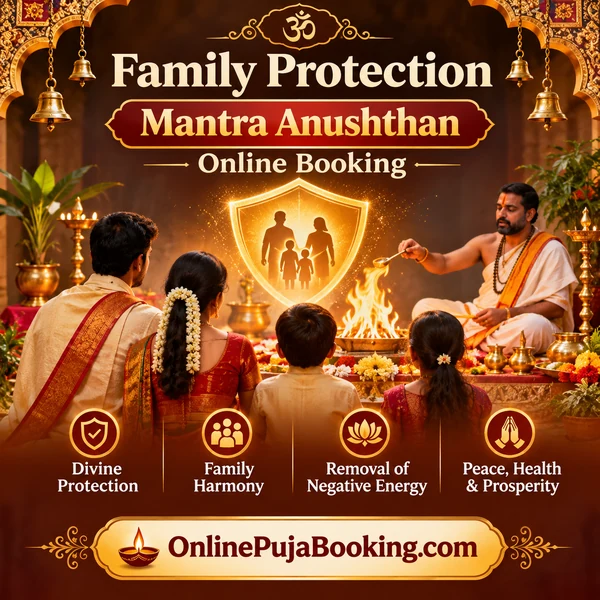

Family Protection Mantra Anushthan Online Booking
Family Protection Mantra Anushthan is a Hindu devotional prayer ceremony performed with the intention of seeking divine blessings for the safety, peace, unity and spiritual well-being of family members. The word Anushthan refers to a disciplined religious observance involving prayers, mantra recitation, worship and other customary spiritual practices.
In Hindu religious traditions, family well-being is often associated with the blessings of protective deities. Devotees offer prayers to divine forms such as Lord Shiva, Goddess Durga and Lord Hanuman, seeking courage, strength, peace and protection for their household.
A Family Protection Mantra Anushthan may be arranged as a collective family prayer or as a dedicated ritual performed on behalf of household members. The exact deity, mantra, duration and ritual procedure depend on the selected tradition and the priest’s guidance.
Through OnlinePujaBooking.com, devotees can explore online booking arrangements for this devotional service and review the details of the available package before confirming.
Religious and Cultural Significance
Family protection has an important place in Hindu devotional life. Traditionally, a household is considered not merely a physical residence but also a place of family responsibilities, spiritual values, relationships and religious observances.
Many Hindu families worship protective deities to seek blessings for their loved ones. Different deities are associated with different aspects of divine protection:
Lord Shiva: Lord Shiva is worshipped as the supreme divine consciousness and as a compassionate protector of devotees. His worship is associated with inner strength, peace, spiritual discipline and the removal of fear.
Goddess Durga: Goddess Durga represents divine Shakti, courage and the victory of righteousness over negative forces. Devotees pray to Maa Durga for strength, protection and the well-being of their families.
Lord Hanuman: Lord Hanuman is revered for devotion, courage, loyalty and strength. Many households recite Hanuman prayers seeking confidence, protection and freedom from fear.
Lord Narasimha: Lord Narasimha, an incarnation of Lord Vishnu, is worshipped as a powerful protector of devotees and a symbol of divine intervention against injustice and oppression.
The particular deity selected for a Family Protection Mantra Anushthan may vary according to family tradition, personal devotion, regional practices or the priest’s recommendation.
It is important to understand that this is a devotional observance. Its religious purpose is to express faith, seek divine grace and encourage positive spiritual values within the family rather than guarantee specific real-world outcomes.
Sanskrit Shloka or Mantra
The following established prayers are relevant to the protective devotional traditions associated with this anushthan. They are presented as commonly recognised prayers, not as a claim that every version of the Family Protection Mantra Anushthan must include both.
1. Durga Mantra
Sanskrit:
ॐ दुं दुर्गायै नमः॥
Roman Transliteration:
Om Dum Durgayai Namah.
Meaning:
Salutations to Goddess Durga, the divine embodiment of strength and protective energy.
Relevance to this Puja:
Devotees may recite this mantra while worshipping Goddess Durga and seeking her blessings for courage, peace and the spiritual well-being of their family. It is a concise devotional mantra suitable for inclusion in a Durga-oriented prayer observance.
2. Hanuman Mantra
Sanskrit:
ॐ हं हनुमते नमः॥
Roman Transliteration:
Om Ham Hanumate Namah.
Meaning:
Salutations to Lord Hanuman, the embodiment of devotion, courage and strength.
Relevance to this Puja:
Lord Hanuman is widely worshipped as a protective and courageous divine figure. Devotees may recite this mantra as part of a Hanuman-oriented family prayer, seeking spiritual strength, confidence and divine blessings.
The priest may select one mantra or a different traditional recitation according to the chosen deity and ritual method.
Traditional Purpose and Devotional Benefits
Hindu families may organise a Family Protection Mantra Anushthan with the following devotional intentions:
- Prayers for Family Safety: Seeking divine blessings for the protection and well-being of family members.
- Peaceful Home Environment: Offering prayers for harmony, understanding and positive relationships within the household.
- Spiritual Strength: Seeking courage, faith and emotional resilience during challenging periods.
- Divine Blessings: Expressing devotion to protective forms of the Divine, such as Maa Durga, Lord Shiva or Lord Hanuman.
- Family Unity: Bringing family members together through collective worship, prayer and Sankalp.
- Positive Religious Environment: Encouraging regular prayer, spiritual discipline and participation in Hindu traditions.
- Gratitude and Devotion: Offering thanks to the Divine and praying for continued guidance in family life.
These are traditional religious intentions and beliefs. The anushthan should not be considered a guarantee against accidents, illness, financial difficulties or other life events.
When Is This Puja Performed?
There is no single universally compulsory date for a Family Protection Mantra Anushthan. Families may arrange it according to their religious preferences, family customs and the availability of the priest.
Some customary occasions include:
- Navratri: Devotees may choose this period for prayers to Goddess Durga and her protective forms.
- Hanuman Worship Days: Tuesday and Saturday are commonly associated with Hanuman devotion in many Hindu traditions.
- Monday: Families devoted to Lord Shiva may prefer Monday for Shiva-related prayers.
- Family Milestones: A new home, a family gathering or another important household occasion may inspire a special prayer.
- Personal Sankalp: Devotees may arrange an anushthan whenever they wish to make a dedicated prayer for their family.
A priest may help identify a suitable muhurat based on the family’s preferences and the specific ritual being arranged. The date should be confirmed before booking.
Who Can Book This Puja?
Family Protection Mantra Anushthan may be suitable for:
Families and Householders: Families wishing to organise a collective devotional prayer for the well-being of all household members.
Married Couples: Couples who want to pray together for peace, mutual understanding and a harmonious family environment.
Parents: Parents who wish to include their children in a traditional prayer for divine blessings and spiritual guidance.
Senior Family Members: Parents, grandparents or other elders who wish to organise a prayer for the entire family.
Devotees Living Away from Their Hometown: Individuals who want to arrange a family-oriented religious ceremony even when relatives live in different places.
New Homeowners: Families beginning a new chapter in a new residence who wish to offer prayers for peace and auspiciousness.
Participation may be arranged according to the selected service format and the priest’s instructions.
Puja Vidhi: How the Ritual Is Traditionally Performed
The exact procedure for Family Protection Mantra Anushthan depends on the deity, mantra, regional tradition and selected ritual package. A customary arrangement may include the following stages:
Step 1: Preparation and Purification
The worship area is cleaned and prepared. The required puja materials, deity image or idol, flowers, lamps and other offerings are arranged. Participants may take a bath and wear clean clothes before the ceremony.
Step 2: Ganesh Puja
Many Hindu rituals begin with prayers to Lord Ganesha, who is worshipped as Vighnaharta, the remover of obstacles. This customary opening prayer seeks auspicious beginnings for the ceremony.
Step 3: Sankalp
The priest guides the main devotee or family representative through the Sankalp. The family expresses its intention to perform the anushthan and offers the prayer for the well-being and spiritual welfare of household members.
Step 4: Kalash Sthapana
Where included in the chosen tradition, a Kalash is established as a sacred ritual symbol. It may be worshipped with water, leaves, flowers and other customary offerings.
Step 5: Main Deity Worship
The selected protective deity is worshipped. Depending on the ritual, this may involve Lord Shiva, Goddess Durga, Lord Hanuman or Lord Narasimha. Offerings such as flowers, incense, lamps, fruits and devotional prayers may be presented.
Step 6: Mantra Jaap
The priest recites the selected mantra according to the prescribed method. The number of repetitions depends on the specific anushthan and package. Family members may participate in the recitation where appropriate.
Step 7: Havan (If Included)
Some versions of the anushthan conclude with a Vedic fire offering. Offerings such as ghee, havan samagri and other prescribed materials are offered into the sacred fire while the relevant mantras are recited.
Havan is not necessarily included in every Family Protection Mantra Anushthan, so customers should verify this before booking.
Step 8: Purnahuti and Aarti
If Havan is performed, it may conclude with Purnahuti. The ceremony may then include Aarti and prayers to the worshipped deity.
Step 9: Prasad and Blessings
Prasad is distributed among the participants. The family concludes the ceremony with prayers for peace, harmony and divine guidance.
This is a general overview of a possible ritual structure, not a mandatory sequence for every tradition. The priest may adapt the procedure according to the selected deity and customary practice.
Puja Samagri
Commonly used materials may include:
- Flowers and flower garlands
- Fresh fruits
- Coconut
- Incense sticks and dhoop
- Ghee or oil lamps
- Cotton wicks
- Kumkum, turmeric and sandalwood paste
- Akshat (unbroken rice grains)
- Betel leaves and betel nuts
- Kalash and clean water
- Seasonal or traditional offerings
- Havan kund and havan samagri, if Havan is included
- Ghee and suitable Havan offerings
- Prasad ingredients
The exact samagri depends on the deity, mantra and ritual format. Customers should confirm whether the selected package includes puja materials, Havan arrangements, flowers, Prasad and other requirements.
Why Book Through OnlinePujaBooking.com?
Arranging a religious ceremony involves coordinating the preferred date, ritual requirements, materials and service arrangements. Online booking can make this process easier by allowing devotees to review the service details before making a booking request.
Through OnlinePujaBooking.com, customers can:
- Explore the Family Protection Mantra Anushthan service online.
- Review the available package information and inclusions.
- Request a preferred date for the ceremony.
- Share relevant booking details and family Sankalp information.
- Communicate questions about the selected ritual and its requirements.
- Review booking confirmation and service arrangements before the ceremony.
The exact service format, location, materials and other arrangements should be checked against the package details and confirmed during booking.
How to Book Family Protection Mantra Anushthan Online
Follow these practical steps to arrange your puja:
Step 1: Explore the Puja Listing
Visit OnlinePujaBooking.com and find the Family Protection Mantra Anushthan service.
Step 2: Review Package Details
Read the available description carefully. Check the deity, mantra, ritual format, Havan inclusion, samagri and other package details.
Step 3: Select Your Preferred Date
Choose your preferred date or submit a date request. The requested date will be subject to availability and confirmation.
Step 4: Provide Booking Information
Share the required customer details and any relevant family Sankalp information requested during the booking process.
Step 5: Confirm Service Arrangements
Clarify the puja location, participation format, samagri arrangements, duration and other relevant details.
Step 6: Receive Booking Confirmation
Complete the booking according to the available payment and confirmation instructions. Keep the confirmation details for future communication.
Frequently Asked Questions (FAQs)
1. What is Family Protection Mantra Anushthan?
Family Protection Mantra Anushthan is a Hindu devotional observance involving prayers and mantra recitation to seek divine blessings for family safety, peace, unity and spiritual well-being.
2. Which deity is worshipped in this anushthan?
The deity depends on the selected ritual tradition. Common choices may include Goddess Durga, Lord Shiva, Lord Hanuman and Lord Narasimha. The specific deity should be confirmed before booking.
3. What is the religious significance of this puja?
The ceremony reflects the Hindu tradition of seeking divine guidance and protection for the household. It provides an opportunity for family members to participate in prayer and express their devotion together.
4. What are the traditional devotional benefits?
Devotees traditionally perform this anushthan with prayers for family harmony, courage, peace, spiritual strength and divine blessings. These are matters of religious faith rather than guaranteed outcomes.
5. When should Family Protection Mantra Anushthan be performed?
It may be arranged according to family tradition, personal Sankalp and priest guidance. Some devotees prefer Navratri, Monday for Shiva worship or Tuesday and Saturday for Hanuman worship. No single date is compulsory for every version.
6. Can this puja be arranged at home?
A home-based ceremony may be possible depending on the selected service format and arrangements. Customers should confirm the location and participation options before booking.
7. Can I book Family Protection Mantra Anushthan online?
Yes. You can explore the service listing on OnlinePujaBooking.com, review the package details, submit your preferred date and follow the booking confirmation process.
8. What samagri is required for this puja?
Common materials may include flowers, fruits, coconut, incense, lamps, turmeric, kumkum, rice and deity-specific offerings. Havan materials are required only if the selected ritual includes Havan. Confirm package inclusions before booking.
9. How long does the anushthan take?
The duration depends on the selected mantra, number of recitations, deity worship and whether Havan is included. Ask for the expected duration of your chosen package before confirming.
10. Can I request a preferred date for the ceremony?
Yes. You may submit your preferred date while booking. The final date depends on availability and confirmation of the service arrangements.
11. What details should I confirm before booking?
Confirm the worshipped deity, mantra or recitation, number of Jaap repetitions if specified, Havan inclusion, samagri, location, expected duration, participant requirements and booking confirmation.
12. Does Family Protection Mantra Anushthan guarantee protection from every problem?
No religious ceremony can guarantee that accidents, illness, disputes or other difficulties will never occur. The anushthan is a devotional practice through which families express faith and seek divine blessings for peace and well-being.
Final Booking Call to Action
Bring your family together in a meaningful act of devotion through Family Protection Mantra Anushthan. Offer prayers to your chosen protective deity and seek blessings for harmony, courage, peace and spiritual well-being. Explore the available packages, review the ritual details and request your preferred date through OnlinePujaBooking.com. Begin your booking with faith, devotion and a clear understanding of the service arrangements.


Reviews
There are no reviews yet.