
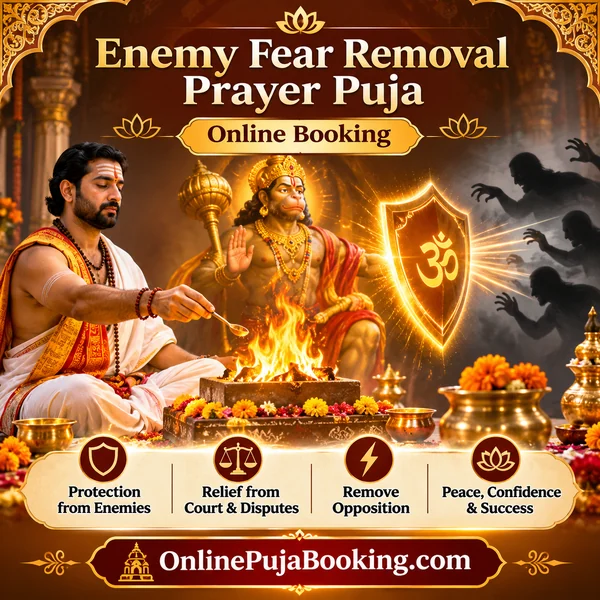


Enemy Fear Removal Prayer Puja Online Booking
Enemy Fear Removal Prayer Puja is a Hindu devotional ritual performed by devotees seeking divine protection, courage, mental strength, and peace when dealing with hostility, fear, disputes, or challenging relationships. In Hindu spiritual traditions, prayers to protective deities are offered to seek blessings for overcoming fear, maintaining righteousness, and responding to difficult situations with wisdom.
The ritual may be dedicated to Lord Hanuman, Lord Narasimha, or Goddess Durga, depending on the devotee’s faith, family tradition, and selected puja arrangement. These deities are widely revered for their protective qualities, divine strength, and association with the removal of fear.
Through Enemy Fear Removal Prayer Puja, devotees express their prayers for protection from harmful intentions, relief from unnecessary fear, and the strength to face difficult circumstances calmly. The purpose is devotional and spiritual rather than an attempt to harm, threaten, or control another person.
OnlinePujaBooking.com provides an online booking option for devotees who wish to explore this prayer service and discuss the available arrangements.
Religious and Cultural Significance
Protection from fear and hostility is an important theme in Hindu devotional traditions. Across different regions of India, devotees worship powerful forms of the Divine when facing uncertainty, opposition, personal difficulties, or situations that require courage.
Three particularly relevant deities are:
1. Lord Hanuman
Lord Hanuman is revered as a symbol of courage, devotion, loyalty, strength, and fearlessness. Devotees regularly recite the Hanuman Chalisa, Hanuman Ashtak, and other prayers seeking his blessings during difficult periods.
His devotion to Lord Rama represents the importance of righteousness, discipline, and selfless service. Prayers to Hanuman are traditionally associated with courage and the ability to face challenges without losing faith.
2. Lord Narasimha
Lord Narasimha is the fierce protective incarnation of Lord Vishnu, depicted with a human body and a lion’s face. His appearance in the story of Prahlada represents divine protection of a devoted follower against oppression.
Devotees worship Lord Narasimha for protection, courage, and the strength to overcome fear and adversity. Narasimha prayers are especially meaningful for those seeking spiritual reassurance during difficult circumstances.
3. Goddess Durga
Goddess Durga represents divine Shakti, courage, righteousness, and protection. Her victory over Mahishasura symbolizes the triumph of divine power over destructive forces.
Devotees worship Goddess Durga to seek strength, confidence, protection, and the ability to face challenging situations with determination.
The exact deity worshipped in this service should be selected according to the chosen ritual package and the devotee’s religious preference.
Sanskrit Shloka or Mantra
The following established devotional mantras are relevant to the protective nature of this puja.
1. Lord Hanuman Mantra
देवनागरी:
ॐ हनुमते नमः॥
Roman Transliteration:
Om Hanumate Namah.
Meaning:
I offer my respectful salutations to Lord Hanuman.
Relevance to this Puja:
Lord Hanuman is worshipped as a symbol of courage, devotion, strength, and fearlessness. Devotees may chant this mantra while praying for protection, confidence, and the strength to face difficult circumstances.
2. Lord Narasimha Mantra
देवनागरी:
ॐ नमो भगवते नरसिंहाय॥
Roman Transliteration:
Om Namo Bhagavate Narasimhaya.
Meaning:
I offer my respectful salutations to Lord Narasimha, the divine protector.
Relevance to this Puja:
Lord Narasimha represents divine protection and the victory of righteousness over oppression. Devotees may recite this mantra to express their prayers for courage, spiritual protection, and peace during periods of fear or hostility.
These mantras may be chanted individually or included in a larger devotional ritual according to the selected puja tradition and the priest’s guidance.
Traditional Purpose and Devotional Benefits
Enemy Fear Removal Prayer Puja is associated with several traditional devotional intentions. These are matters of religious belief and personal faith, not guaranteed real-world results.
Devotees may perform this puja with the following intentions:
- Prayer for Divine Protection: Seeking blessings from protective deities during situations involving hostility, uncertainty, or fear.
- Courage and Confidence: Praying for the inner strength to face difficult circumstances with determination.
- Relief from Fear: Seeking spiritual reassurance when experiencing anxiety about disputes, opposition, or difficult relationships.
- Peaceful Relationships: Praying for the reduction of hostility, misunderstandings, and unnecessary conflict.
- Wisdom and Discernment: Seeking divine guidance to make thoughtful decisions rather than reacting impulsively.
- Faith and Mental Strength: Developing patience, devotion, and confidence through prayer and mantra recitation.
- Victory of Righteousness: Expressing the wish to remain truthful, ethical, and peaceful even when facing opposition.
The puja should be understood as a spiritual practice. It does not replace practical steps such as seeking appropriate legal advice, resolving disputes through peaceful communication, or contacting authorities when safety is at risk.
When Is This Puja Performed?
Enemy Fear Removal Prayer Puja does not have one universally mandatory date or tithi. It may be performed according to the devotee’s needs, family tradition, and the guidance of the priest.
Some commonly preferred occasions include:
Tuesday: Tuesday is traditionally associated with Lord Hanuman and is considered a suitable day by many devotees for Hanuman worship.
Saturday: Many devotees worship Lord Hanuman on Saturdays and offer prayers for courage, discipline, and protection.
Narasimha Jayanti: This festival commemorates the appearance of Lord Narasimha and is an important occasion for devotees of this protective form of Lord Vishnu.
Navratri: Devotees worship Goddess Durga during Navratri, making this a meaningful period for prayers seeking divine strength and protection.
Personal Difficulties: Families and individuals may arrange the puja when facing persistent fear, disputes, workplace hostility, or other challenging circumstances.
The preferred date should be discussed during booking. An auspicious muhurat may be selected according to the relevant regional tradition and priest’s guidance.
Who Can Book This Puja?
Enemy Fear Removal Prayer Puja may be relevant to different categories of devotees.
Individuals Facing Personal Conflicts
People experiencing hostility, disagreements, or difficult interpersonal situations may arrange this puja to pray for courage and peace.
Families Seeking Peace and Protection
Householders may perform the ritual with prayers for family harmony, spiritual protection, and a peaceful home environment.
Business Owners and Professionals
People experiencing workplace disagreements, business conflicts, or professional opposition may seek divine blessings for patience, wisdom, and ethical decision-making.
Devotees Experiencing Fear or Uncertainty
Individuals who feel spiritually unsettled during challenging periods may arrange this prayer to strengthen their faith and devotion.
Hanuman, Narasimha, and Durga Devotees
Devotees who regularly worship these deities may choose this puja as an extension of their personal devotional practice.
The ritual is open to devotees regardless of gender or marital status, subject to the customary requirements of the chosen tradition.
Puja Vidhi: How the Ritual Is Traditionally Performed
The exact procedure depends on the deity selected, regional customs, and the priest conducting the ritual. A possible structure for this devotional service is outlined below.
Step 1: Preparation and Purification
The worship area is cleaned and arranged respectfully. The devotee and priest prepare for the ritual according to customary purification practices.
Step 2: Sankalp (Sacred Intention)
The devotee takes a sankalp, expressing the purpose of the prayer. This may include seeking courage, divine protection, relief from fear, and peace in difficult circumstances.
The sankalp should focus on positive and ethical intentions rather than wishing harm upon another person.
Step 3: Invocation of the Chosen Deity
The priest invokes the deity selected for worship.
Depending on the arrangement, this may involve Lord Hanuman, Lord Narasimha, or Goddess Durga.
Step 4: Ganesh Vandana
In many Hindu ritual traditions, prayers to Lord Ganesha are offered at the beginning to seek blessings and a smooth completion of the ceremony.
Step 5: Main Puja and Offerings
The deity is worshipped with appropriate offerings, such as flowers, incense, lamps, and other customary items.
The offerings depend on the particular deity and ritual tradition.
Step 6: Mantra Jaap or Stotra Recitation
The priest may recite the relevant deity mantra, devotional hymn, or stotra.
Examples include:
- Hanuman Mantra Jaap.
- Hanuman Chalisa Path.
- Narasimha Mantra Jaap.
- Narasimha Kavach Path.
- Durga Mantra Jaap.
- Durga Stuti.
The actual recitation should match the selected package rather than being assumed to be included in every booking.
Step 7: Havan (If Included)
Some arrangements may include a havan. In this ritual, offerings are made into the sacred fire while appropriate mantras are recited.
A havan should only be considered included when it is explicitly mentioned in the selected package.
Step 8: Aarti and Prarthana
The ceremony concludes with aarti and personal prayers. Devotees express gratitude and seek blessings for courage, peace, protection, and righteous conduct.
Step 9: Purnahuti and Completion
If a havan is performed, the priest may offer purnahuti according to the ritual tradition. The ceremony is concluded with prayers and blessings.
The procedure described above is a general devotional framework, not a compulsory sequence for every regional tradition.
Puja Samagri
The materials required depend on the chosen deity and ritual format.
Commonly used items may include:
- Photograph or idol of the selected deity.
- Flowers and garlands.
- Incense sticks and dhoop.
- Ghee or oil lamp.
- Cotton wicks.
- Kumkum and turmeric.
- Akshat (unbroken rice).
- Fruits and seasonal offerings.
- Sweets or appropriate naivedya.
- Betel leaves and nuts, where customary.
- Kalash and water.
- Sandalwood paste.
- Camphor for aarti.
- Havan kund and havan samagri, if havan is included.
For Hanuman worship, sindoor and traditional offerings may also be used according to local custom.
For Narasimha or Durga worship, offerings and materials may differ according to the specific sampradaya.
Important: Customers should confirm whether puja samagri, havan materials, deity arrangements, and other requirements are included in their selected booking package. The exact list may vary.
Why Book Through OnlinePujaBooking.com?
Arranging a traditional Hindu puja involves understanding the ritual, selecting a suitable date, and communicating the required arrangements.
OnlinePujaBooking.com offers a convenient way to explore Enemy Fear Removal Prayer Puja and review the available booking details.
Convenient Online Booking
Explore the service online without needing to begin the booking process through an in-person visit.
Clear Package Information
Review the listed puja details and check which ritual components are included before proceeding.
Preferred Date Request
Share your preferred date and ask about availability before confirming the booking.
Communication About Ritual Arrangements
Discuss the selected deity, puja format, samagri requirements, and any additional arrangements that may be needed.
Respect for Religious Traditions
The ritual should be arranged with consideration for the relevant Hindu customs, devotional practices, and regional traditions.
Booking Clarity
Review the service details and obtain confirmation of the agreed arrangements before the puja takes place.
How to Book Enemy Fear Removal Prayer Puja Online
Booking this puja through OnlinePujaBooking.com can be approached in a few simple steps.
- Find the Puja Service: Visit OnlinePujaBooking.com and locate Enemy Fear Removal Prayer Puja.
- Review the Package: Check the selected ritual format, inclusions, duration, samagri details, and other available information.
- Choose Your Preferred Date: Select or request a suitable date for the puja, subject to availability.
- Provide Booking Details: Share the necessary contact information and details required to arrange the ceremony.
- Confirm the Ritual Requirements: Discuss the preferred deity, mantra recitation, havan requirements, and any special requests.
- Receive Booking Confirmation: Proceed after the service arrangements and applicable booking details have been communicated and confirmed.
Customers should retain their booking confirmation and refer to the agreed package details before the scheduled ceremony.
Frequently Asked Questions (FAQs)
1. What is Enemy Fear Removal Prayer Puja?
Enemy Fear Removal Prayer Puja is a Hindu devotional ritual performed to seek divine protection, courage, spiritual strength, and peace when facing hostility, fear, or difficult circumstances.
2. Which deity is worshipped in this puja?
The ritual may be dedicated to Lord Hanuman, Lord Narasimha, or Goddess Durga. The deity depends on the devotee’s preference and the selected puja arrangement.
3. What is the religious significance of this puja?
The puja reflects the Hindu devotional belief that prayer to protective forms of the Divine can help devotees develop courage, faith, patience, and strength during challenging situations.
4. What are the traditional devotional benefits?
Devotees traditionally pray for protection, relief from fear, family peace, confidence, wisdom, and the ability to face hostility with patience and righteousness. These are spiritual intentions, not guaranteed outcomes.
5. Which day is suitable for Enemy Fear Removal Prayer Puja?
Tuesday and Saturday are commonly preferred for Lord Hanuman worship. Narasimha Jayanti and Navratri may also be meaningful occasions, depending on the selected deity and tradition. There is no single mandatory date for every version of this puja.
6. Can this puja be performed at home?
Yes. A home-based ritual may be arranged according to the selected tradition and available arrangements. Customers should confirm the venue and ritual requirements before booking.
7. Can I book Enemy Fear Removal Prayer Puja online?
Yes. You can explore the service through OnlinePujaBooking.com, review the available package information, submit your preferred date, and communicate the required arrangements.
8. What samagri is required for this puja?
Common items may include flowers, incense, lamps, fruits, sweets, kumkum, turmeric, and deity-specific offerings. Additional materials may be required if mantra jaap or havan is included.
9. How long does the puja take?
The duration depends on the selected ritual. A simple devotional puja may take less time than an arrangement involving extended mantra jaap, stotra recitation, or havan. Confirm the expected duration before booking.
10. Can I request a particular date for the puja?
Yes. You may request your preferred date during booking. The final schedule depends on availability and the arrangements confirmed for the selected service.
11. Can I choose between Hanuman, Narasimha, and Durga worship?
The preferred deity can be discussed when arranging the service. Customers should confirm which deity-specific options are actually available before completing their booking.
12. Does Enemy Fear Removal Prayer Puja guarantee victory over enemies?
No. A religious ritual cannot guarantee victory, control another person, or ensure that a dispute will end. The puja is a devotional practice intended to express prayers for courage, protection, peace, and wisdom. Practical disputes should also be handled through lawful and appropriate means.
Book Enemy Fear Removal Prayer Puja Online
When facing fear, hostility, or difficult relationships, prayer can provide a meaningful opportunity to reconnect with faith, courage, and spiritual discipline. Enemy Fear Removal Prayer Puja allows devotees to seek the blessings of Lord Hanuman, Lord Narasimha, or Goddess Durga according to their chosen tradition.
Explore the available Enemy Fear Removal Prayer Puja booking options at OnlinePujaBooking.com. Review the package details, communicate your preferred date, and confirm the ritual arrangements before proceeding with your booking.
Reviews
There are no reviews yet.