
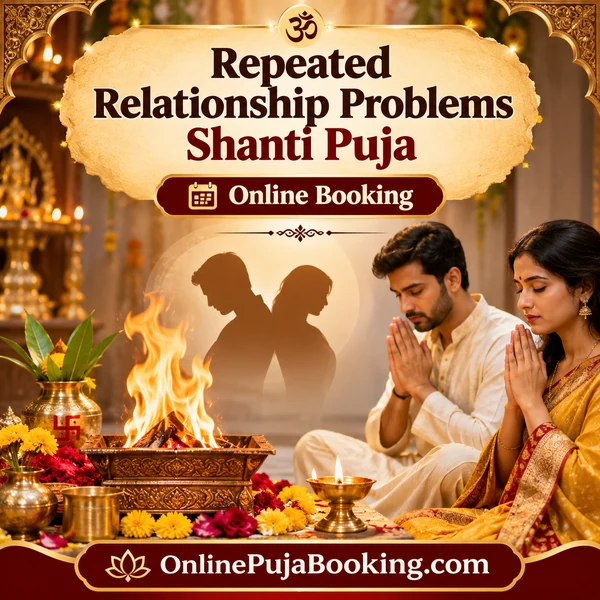

Repeated Relationship Problems Shanti Puja Online Booking
Relationships are an important part of family and social life in Hindu tradition. Marriage, companionship, mutual respect, affection, and family harmony are often regarded as blessings that deserve care and prayer. However, couples and families may sometimes experience recurring disagreements, misunderstandings, communication difficulties, or emotional distance.
Repeated Relationship Problems Shanti Puja is a devotional prayer ceremony for people who wish to seek divine blessings for peace, patience, understanding, and harmony in their relationships. Through traditional worship, mantra chanting, offerings, and prayers, devotees express their intention to move towards a more peaceful and respectful personal life.
You can explore Repeated Relationship Problems Shanti Puja Online Booking through OnlinePujaBooking.com and review the available service arrangements before selecting your preferred date.
Religious and Cultural Significance
In Hindu religious traditions, harmony between people is often connected with the blessings of divine couples and forms of the Divine associated with love, devotion, compassion, and family life.
Lord Shiva and Goddess Parvati are widely revered as an ideal divine couple. Their worship is associated with marital devotion, mutual respect, strength, and the balance of complementary energies. Devotees may pray to Uma-Maheshwara when seeking blessings for a peaceful married life.
Radha and Lord Krishna represent divine love and devotion in many Hindu devotional traditions. Their worship may be included when devotees wish to cultivate affection, sincerity, and devotion in their relationships.
Lakshmi-Narayana worship is another traditional expression of prayer for household well-being, stability, prosperity, and harmony.
The precise form of worship for a relationship-focused Shanti Puja is not fixed universally under one standard scriptural procedure. The deity, mantras, offerings, and ritual sequence may depend on the priest’s guidance, family tradition, regional practice, and the devotee’s Sankalpa.
This puja should be understood as a spiritual expression of hope and a prayer for positive change. It is not a substitute for honest communication, mutual consent, counselling, or practical steps to address relationship difficulties.
Sanskrit Shloka or Mantra
The following established devotional mantras may be included according to the deity selected for the puja.
1. Lord Shiva Mantra
Sanskrit:
ॐ नमः शिवाय॥
Roman Transliteration:
Om Namah Shivaya.
Meaning:
I bow to Lord Shiva, the auspicious and benevolent Divine.
Relevance to This Puja:
Lord Shiva is traditionally worshipped for peace, spiritual strength, and auspiciousness. This mantra may be chanted during Shiva-Parvati worship as a prayer for calmness, patience, and harmony in family life.
2. Lord Vishnu Mantra
Sanskrit:
ॐ नमो भगवते वासुदेवाय॥
Roman Transliteration:
Om Namo Bhagavate Vasudevaya.
Meaning:
I offer my salutations to Lord Vasudeva, the Supreme Divine.
Relevance to This Puja:
This well-known Vishnu mantra is used in devotional worship and prayer. It may be included when the ritual invokes Lord Vishnu or Lakshmi-Narayana for household peace, devotion, and spiritual well-being.
The selected mantras and their chanting counts should be confirmed with the performing priest. Devotees may also participate in chanting according to their comfort and tradition.
Traditional Purpose and Devotional Benefits
Devotees may perform Repeated Relationship Problems Shanti Puja with the following traditional devotional intentions:
- Prayer for Mutual Understanding: To seek divine blessings for better understanding and respectful communication between partners.
- Peace in Married Life: To express prayers for affection, patience, and stability in marital relationships.
- Family Harmony: To seek blessings for a peaceful atmosphere among family members.
- Emotional Strength: To pray for the patience and clarity needed when facing personal difficulties.
- Reduction of Conflict: To express a spiritual intention to move away from repeated arguments and misunderstandings.
- Renewed Commitment: To seek blessings for sincerity, trust, and mutual responsibility in relationships.
- Household Well-being: To pray for an atmosphere of compassion, cooperation, and happiness at home.
These are traditional spiritual intentions, not guaranteed outcomes. The effectiveness of a relationship also depends on the choices, communication, consent, and efforts of the people involved.
When Is This Puja Performed?
Repeated Relationship Problems Shanti Puja may be arranged whenever devotees feel the need to pray for peace and harmony in their personal or family relationships.
Some families prefer to perform relationship-related worship on occasions associated with Lord Shiva and Goddess Parvati, including:
- Monday: Traditionally associated with the worship of Lord Shiva.
- Pradosh Tithi: Considered an important occasion for Shiva worship.
- Maha Shivaratri: A major festival dedicated to Lord Shiva.
- Hartalika Teej: Observed by many devotees in connection with Goddess Parvati and marital devotion.
- Teej and other marital observances: Regional customs may include prayers for the well-being of married life.
- Wedding anniversaries: Some couples choose to offer prayers on meaningful personal occasions.
The appropriate date and timing can vary according to the family’s tradition and the priest’s advice. There is no single universally compulsory date for this particular relationship-focused Shanti Puja.
Who Can Book This Puja?
This puja may be suitable for different devotees who wish to pray for peace and understanding in their personal relationships.
Married Couples: Partners experiencing recurring disagreements or communication difficulties may arrange the puja together as a shared prayer for harmony.
Husbands and Wives: Either spouse may wish to offer prayers for patience, mutual respect, and the well-being of married life.
Families: Family members may arrange a prayer ceremony when ongoing disagreements are affecting the peaceful atmosphere at home.
Individuals: A person may book the puja with a personal Sankalpa for emotional strength, clarity, and healthier relationships.
Parents and Well-Wishers: Family members may arrange the ceremony with the intention of praying for the happiness and well-being of their loved ones.
Participation by both partners is welcome where mutually desired, but it should never be forced. The Sankalpa and ritual arrangements can be discussed with the priest.
Puja Vidhi: How the Ritual Is Traditionally Performed
The exact procedure for Repeated Relationship Problems Shanti Puja may differ according to the deity invoked and the regional tradition followed by the priest. The following is a general outline of how a customized devotional ceremony may be conducted.
1. Preparation of the Puja Space
The worship area is cleaned and arranged respectfully. A suitable place is prepared for the deity’s image or idol, Kalash, lamps, flowers, and other ritual materials.
2. Sankalpa
The devotee or priest takes a Sankalpa, stating the intention of the ceremony. The prayer may be dedicated to peace, mutual understanding, patience, and harmony in relationships.
3. Ganesh Puja
Lord Ganesha is traditionally worshipped at the beginning of many Hindu ceremonies. Prayers are offered for an auspicious and orderly commencement of the ritual.
4. Kalash Sthapana and Preliminary Prayers
Where prescribed by the chosen tradition, a Kalash is established and preliminary prayers are performed. These steps prepare the ceremonial setting for the main worship.
5. Main Deity Worship
The priest worships the selected deity or divine couple. Depending on the Sankalpa, this may involve Shiva-Parvati, Radha-Krishna, or Lakshmi-Narayana. Offerings such as flowers, incense, lamps, and fruits may be presented.
6. Mantra Jaap
Relevant devotional mantras are chanted according to the chosen form of worship. The priest determines the appropriate mantra and chanting procedure based on the ritual tradition.
7. Shanti Prarthana
Special prayers are offered for peace, compassion, understanding, and the well-being of the family. Devotees may join in prayer or repeat the selected mantra.
8. Havan, If Included
Some packages or ritual traditions may include a Havan. In that case, the priest performs the fire ceremony using prescribed offerings while reciting appropriate mantras.
9. Purnahuti and Aarti
If a Havan is performed, it is concluded with Purnahuti according to the selected procedure. Aarti and final prayers may follow.
10. Prasad and Blessings
The ceremony concludes with the distribution of Prasad, where arranged, and prayers for the well-being of the devotees and their families.
The above is an indicative outline, not a mandatory or universal Vedic procedure. The final Vidhi should be confirmed with the priest before booking.
Puja Samagri
The materials required depend on the deity worshipped and the selected ritual package. Commonly used items may include:
- Flowers and garlands
- Fresh fruits
- Incense sticks and Dhoop
- Ghee or oil lamps
- Cotton wicks
- Kumkum and Haldi
- Akshat (unbroken rice grains)
- Sandalwood paste
- Betel leaves and betel nuts
- Coconut
- Kalash and clean water
- Panchamrit ingredients, if required
- Camphor for Aarti
- Havan Samagri and ghee, if Havan is included
- A printed or digital prayer and mantra text, where needed
Not every item is required for every version of this puja. Please review the selected package and confirm whether the priest, Havan arrangements, and puja samagri are included or need to be arranged separately.
Why Book Through OnlinePujaBooking.com?
Arranging a religious ceremony can involve several details, including selecting a preferred date, understanding the ritual, checking the materials required, and coordinating with the performing priest.
OnlinePujaBooking.com provides an online platform through which devotees can explore puja services and review booking details before making a selection.
Convenient Online Enquiry: Explore the Repeated Relationship Problems Shanti Puja service without needing to begin the arrangements through an in-person visit.
Package Information: Review the available package details and check what is included before proceeding.
Preferred Date Request: Share your preferred date and enquire about availability before the booking is confirmed.
Clear Communication: Provide the details needed for the ritual and clarify any questions about the ceremony.
Respect for Religious Traditions: Discuss the intended deity, Sankalpa, and ritual preferences so that the arrangements can be understood in advance.
Booking Clarity: Confirm the service arrangements, location or mode of performance, samagri requirements, and any additional inclusions before proceeding.
The exact services and arrangements depend on the package selected and confirmation received during booking.
How to Book Repeated Relationship Problems Shanti Puja Online
Follow these practical steps to enquire about and book the puja:
Step 1: Explore the Puja Service
Visit OnlinePujaBooking.com and find the Repeated Relationship Problems Shanti Puja listing.
Step 2: Review Package Details
Read the description carefully. Check the ritual format, package inclusions, samagri arrangements, and any optional services.
Step 3: Select Your Preferred Date
Choose or request a suitable date. The date will be subject to availability and confirmation.
Step 4: Provide the Required Details
Enter the requested booking information, such as the devotee’s name, contact details, location, and any relevant Sankalpa information.
Step 5: Confirm the Arrangements
Clarify whether the puja will take place at home or through another available arrangement. Confirm the priest, ritual duration, samagri, and package inclusions as applicable.
Step 6: Complete Your Booking
Proceed according to the website’s booking and payment instructions. Keep the booking confirmation for future communication.
Frequently Asked Questions (FAQs)
1. What is Repeated Relationship Problems Shanti Puja?
It is a devotional Hindu prayer ceremony arranged with the intention of seeking divine blessings for peace, understanding, patience, and harmony in personal and family relationships.
2. Which deity is worshipped in this puja?
Depending on the ritual tradition, the priest may worship Lord Shiva and Goddess Parvati, Radha-Krishna, or Lakshmi-Narayana. The selected deity should be confirmed before the ceremony.
3. What is the religious significance of this puja?
The puja provides an opportunity for devotees to pray for mutual respect, affection, peaceful communication, and harmony in relationships through traditional Hindu worship.
4. What are the traditional devotional benefits?
Devotees traditionally pray for patience, emotional strength, family peace, understanding, and a more harmonious married or personal life. These are spiritual intentions, not guaranteed results.
5. When should this puja be performed?
It can be arranged when devotees wish to pray for relationship harmony. Monday, Pradosh, and occasions associated with Shiva-Parvati worship may be considered, depending on family custom and priestly guidance.
6. Can this puja be arranged at home?
Home worship may be possible depending on the selected package and service arrangements. Confirm the location, priest availability, and required arrangements before booking.
7. Can I book Repeated Relationship Problems Shanti Puja online?
Yes. You can explore the service on OnlinePujaBooking.com, review the package information, request a preferred date, and follow the booking instructions provided on the website.
8. What samagri is required for this puja?
Common materials may include flowers, fruits, incense, lamps, kumkum, Haldi, coconut, Kalash, and other items appropriate to the selected deity. Havan materials are needed only if a Havan is included.
9. How long does the puja take?
The duration depends on the selected Vidhi, mantra chanting, and whether Havan is included. Ask for the estimated duration when confirming your package.
10. Can I request a preferred date?
Yes. You may request your preferred date during the booking process. The date should be treated as a request until availability and arrangements are confirmed.
11. What should I confirm before booking?
Confirm the selected deity, Sankalpa, ritual procedure, location or mode of worship, estimated duration, priest arrangements, samagri inclusions, package price, and booking confirmation.
12. Does this puja guarantee that relationship problems will end?
No. Hindu puja is a form of devotion and prayer, not a guarantee of a particular personal outcome. Healthy relationships also require communication, mutual consent, respect, and practical effort. Where needed, professional relationship counselling may also be helpful.
Book Repeated Relationship Problems Shanti Puja Online
If you wish to offer prayers for greater peace, understanding, and harmony in your personal or family relationships, explore Repeated Relationship Problems Shanti Puja Online Booking through OnlinePujaBooking.com. Review the available package details, discuss the ritual arrangements, and request a suitable date. May your prayers inspire patience, compassion, mutual respect, and a peaceful atmosphere in your family life.
Reviews
There are no reviews yet.